
(Irfan is a Young Guardian at Fitzrovia Youth in Action and joined us at Camden Giving as part of the You Decide Mental Health project as a community researcher)
I joined the project because I wanted to understand how decisions are made in Camden and, more importantly, how those decisions affect the people who live here. As the youngest of the community researchers, I wanted to bring a younger perspective to conversations about mental health. I also wanted to learn how funding, and the decisions behind it, can either make support easier to reach or put obstacles in people’s way.
I interviewed five people of different ages, both young people and adults, so I could hear a range of perspectives rather than focusing on one kind of experience. I chose people from groups known to be at higher risk of suicide, because I wanted to understand the experiences of those who may be most vulnerable when it comes to their mental health.
Sometimes people just need to be listened to
Before the interviews, I assumed people might find it hard to open up. Mental health is personal and sensitive, and I wasn’t sure how much people would want to share. What I found was that sometimes people simply need someone who is willing to listen without judgement.
One message came through clearly: getting support can be really difficult, often because of long waits for things like GP appointments. That changed how I saw the problem. People are often willing to ask for help. The problem is that the help isn’t always there when they need it.
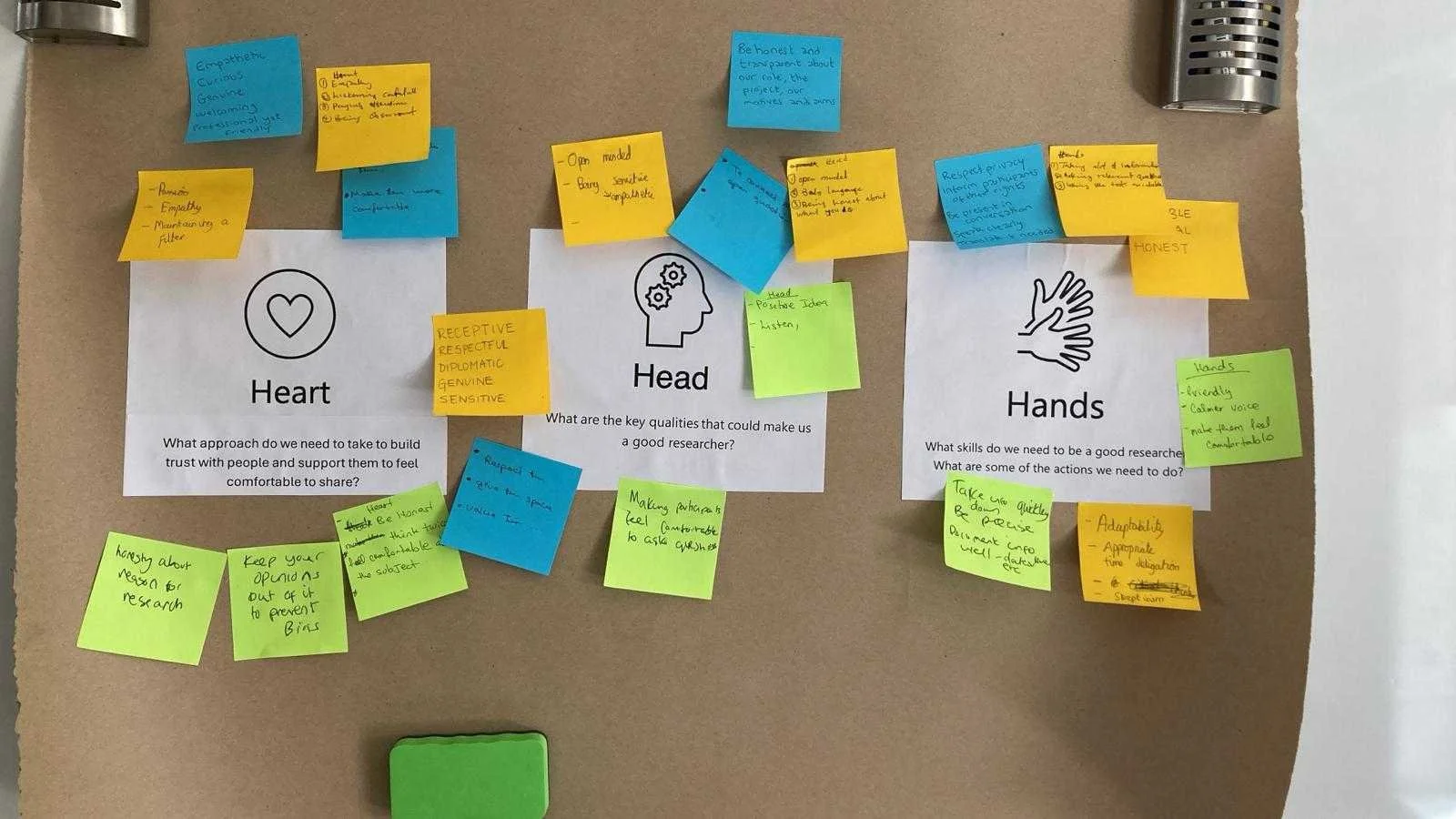
A brown flip chart with three white sheets saying Heart, Head, Hands having coloured post-it notes around them describing the qualities of a researcher.
What makes good support good
The biggest thing I learnt is that good mental health support isn’t only about whether services exist. It’s also about whether people can reach them at the right time and whether they feel comfortable using them.
I also learnt how important it is to listen directly to people with lived experience instead of making assumptions about what communities need. For funders and institutions, my message would be this: simple opportunities to talk and be heard can make a real difference. Delays in getting formal support can leave people with nothing at the moment they need it most.
From research to action
What we heard will shape the next stage of the project, including how £100,000 of funding is distributed. For me, the project showed that giving communities a genuine voice makes funding decisions more connected to what people are actually living through.
What stays with me most is the responsibility of being trusted with someone else’s experience. I hope our work becomes more than research on paper and turns into something people can genuinely feel in their everyday lives. That’s what has made this experience meaningful for me.
About the project: Camden Giving carried out community-led research with nine Camden residents to understand people’s experiences of mental health in the borough. We asked where people go for support, what makes getting support easier or harder, and what good support looks like. We are now using the findings and recommendations from this phase, along with feedback from our Alumni community, to shape a Mental Health Fund. The same group of community researchers will award grants to organisations working to improve people’s mental health in Camden.
If anything in this post has affected you, support is available:
Samaritans: call 116 123 for free, any time, day or night.
Mind Infoline: call 0300 123 3393, Monday to Friday, 9am to 6pm.