What does safety actually feel like? Women’s experiences of public spaces in Camden
Earlier in the year, we partnered with UCL Citizen Science Academy, Camden Council, and a cohort of 10 Camden residents, to conduct community research or citizen social science, into Women’s safety in public spaces in Camden.
Each citizen scientist (CS) designed their own methodology and conducted independent fieldwork, with training and guidance from UCL and pastoral support and insights from Camden, which together have culminated in over 100 recommendations! Some of them may lead to quick wins, while others may take time in leading to systemic change.
Our Alumni Manager, Puja, caught up with one of the citizen scientists, Fatima, to learn more about her experience with this project, including the biggest learnings and challenges, and how community organisations like Camden Giving use learnings from citizen science and community research effectively.
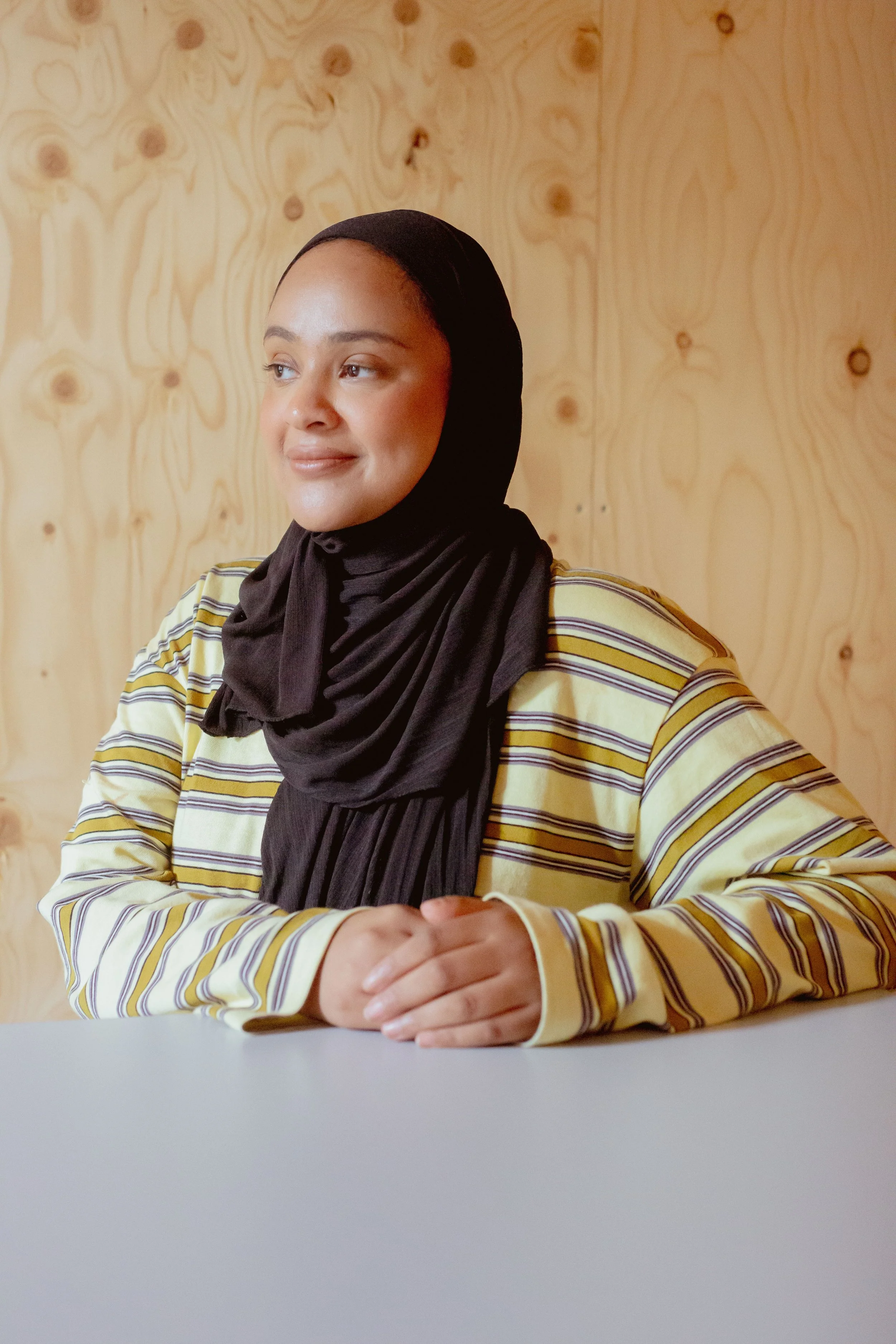
A medium close-up portrait of Fatima, a woman wearing a black hijab and a pale yellow striped long-sleeve top, seated at a light-coloured table against a natural wood-paneled wall.
Meet Fatima
Puja: We know each other well, but for those reading, could you share a little bit about yourself?
Fatima: I am Fatima Sharif. My background is clinical. I trained as a Physician Associate with placements across paediatrics and oncology, so I have spent years learning to listen carefully and notice what is not being said.
I moved into community research and software engineering after that, and I run Self Sufficient Women CIC, supporting women's economic independence, alongside a weekly Science Club for children from underrepresented communities in Camden.
This project sits right at the intersection of those two worlds: clinical attentiveness to lived experience, and a commitment to community-led work.
Puja: What do you think drew you towards this citizen science project?
Fatima: I kept noticing the gap between how safety is measured and how it is actually felt.
Camden Town has Safe Haven schemes on paper, but almost none of the women I spoke to had ever heard of them. In my research, 99% had never heard of a Safe Haven scheme, yet 80 to 90% told me they felt unsafe in Camden at night.
That gap between provision and lived experience is exactly what pulled me in. I wanted to bring a psychoanalytic, qualitative lens to a problem that is usually treated with signage and CCTV.
Safety isn't fixed
One of the most interesting things to emerge from Fatima's research was that women's experience of safety can change depending on where they are, what is happening around them and even what time it is.
Puja: Have there been any interesting or unexpected learnings along the way? If you had to name two or three big takeaways, what would they be?
Fatima: Avoidance is automatic. Women adjust pace, routes and eye contact without consciously deciding to. Buck Street alleys came up repeatedly as the highest avoidance hotspot, and most women could not immediately articulate why. It was instinctive rather than reasoned.
Safety is temporal, not fixed. The same street that feels fine at 3pm becomes threatening between 9pm and midnight. That window came up again and again as the peak time women feel least safe.
Design and policy tend to treat spaces as safe or unsafe in a fixed way, but that is not how women actually experience them.
Informal havens already exist and formal ones do not. Women navigate instinctively to coffee shops and Tube stations for refuge, not to the designated Safe Haven points.
One participant said the feeling of safety came from people, not buildings, and that has stayed with me throughout the write-up.
Holding space for difficult conversations
Community research can create space for people to share experiences that might not otherwise be heard. But that also comes with responsibility.
Puja: Was there anything that you found challenging about doing this work?
Fatima: Yes. Holding space for the workshop conversations was harder than I expected.
Psychoanalytic dialogue asks people to feel into an experience rather than explain it, and some of what surfaced was painful, including one participant naming her fear that Safe Haven staff would probably also be men.
Staying attuned and non-judgemental in that moment, rather than moving to reassure or fix, took real discipline.
Logistically, recruiting a genuinely diverse sample of 30-plus women within a tight spring timetable was also a stretch, alongside running structured Tavistock observation sessions without an observer effect.
From research to action
Fatima: Camden Giving funds a lot of grassroots, community-led work. When you have seen a piece of research like this move from findings into actual funded action, what made the difference, and where has that handoff typically broken down in your experience?
Puja: Well, we’re trying to make that happen with this project itself actually! I think some of the recommendations that have come out of this research, from you as well as your peers, might take more time to come to fruition. For instance, addressing misogyny in young men would be a longer-term, structural piece of work, involving schools, youth centres, and families, but there have also been practical recommendations that can be actioned quickly with a bit of funding.
We organised a drop-in for all the citizen scientists who may be interested in applying for small grants through the We Make Camden Kit. If they wanted to implement one of their recommendations, like translating information materials on Safe Havens into languages other than English, for example, they could apply for funding to do it. One of them has already applied for some funding to continue doing the photo walks she used in her research methodology.
We are working on another piece of community research into health, wherein the research findings will be used to shape a new fund and the researchers will go on to fund organisations working in health. So watch this space!
What happens after the research?
Fatima: From where you sit, what would meaningful follow-through from Camden Council actually look like for a piece of resident-led safety research, and who tends to hold that accountability once the funding period ends?
Puja: Ongoing feedback. Keeping us and residents posted on what conversations happen across teams, and what changes are seen because of the recommendations. Again, I appreciate sometimes it can be hard to trace back a policy change or a new initiative to an exact recommendation from one particular piece of research, but I think keeping open communication about the progress that happens is important.
Camden also does a good job of bringing residents into conversations about accountability, whether it is through full council Town Hall meetings, Citizens’ Assemblies or the WMCK Summit, and that is important with a piece of research like this. I think it’s equally our onus (the voluntary and community sector) to keep following up to see where these recommendations land.
Measuring safety isn't enough
The research raises a bigger question about how we understand safety in the first place.
As Fatima puts it:
“I wish the people paying for this research would make it feel safe and not just call it safe out of convenience.”
The challenge is not simply to measure whether a space is safe. It is to listen to the people using it, understand what makes them feel safe, and then act on what they tell us.
We keep asking women to trust spaces that have only ever been measured, never felt.
Fatima’s research project was titled ‘Safety as a Feeling: Women's Perceptions of Safe Havens in Camden Town’. We’ll share a link to the final copy of the webzine with all the research recommendations once it is published.