
What happens when systems thinking meets participatory grant-making?
At Camden Giving, we trust local people to make decisions about where funding should go. We do this because people living and working in Camden hold knowledge that cannot always be captured in an application form, a set of statistics or a funder’s strategy.
But sharing decision-making power does not automatically make those decisions simple.
Our resident panels regularly compare very different ideas. A one-day community event might create joy and connection. A food project might respond to an immediate need. A programme of advice or training might improve somebody’s life over time. Another project might try to change the conditions that created the problem in the first place.
So we ask ourselves:
How do we compare them fairly?
How do we look beyond what a project is doing and think about what it could change?
And how do we make space for different interpretations without losing sight of what the fund was created to achieve?
These questions led us to create our own Tools for Thinking Cookbook: recipes and tips for applying systems thinking to participatory grant-making.
Making systems thinking feel less intimidating
“Systems thinking” can sound like something reserved for strategy documents or specialist conversations.
But, at its heart, it is simply about looking at how things connect. It helps us look beyond one activity or problem and consider the relationships, structures, assumptions and power dynamics shaping what happens. For participatory grant-making, this matters.
We know that when residents make funding decisions, power shifts. When people with lived experience challenge what counts as good evidence, funders learn. When a panel notices that communities are responding to needs in ways that do not neatly fit our funding criteria, we have an opportunity to question the fund itself, rather than only questioning the applicant.
That does not mean every small community project needs to “change the system”. Sometimes a project giving somebody a good day is exactly what is needed. Sometimes ongoing support helps somebody build a good life. Sometimes a project begins to shift something bigger around them. Sometimes it can do all three.
Why a cookbook?
We did not want to produce another technical guide that people would need to translate before using it with a community panel.
So, we turned the tools into recipes.
Each recipe includes preparation time, cooking time, suggested group sizes and questions to help guide the conversation. The cooking theme keeps the resource approachable, while the conversations it supports help people explore complex questions about change, power and impact.
The cookbook includes three tools:
The Uncomfortable Pyramid helps groups explore the connection between a visible challenge, the assumptions underneath it and the kinds of projects that could respond to both.
Good Day, Good Life, Good System helps panels think about the level of change a project is trying to create, without suggesting that one type of impact is automatically more valuable than another.
Square Peg in a Round Hole helps panels consider the relationship between a good idea and the purpose of a particular fund. It creates space to ask whether a project genuinely falls outside the criteria, or whether the fund is interpreting community responses too narrowly.
The tools are not a scoring system and they do not tell a panel what decision to make. They help people slow down, look at an application from different angles and explain the thinking behind their judgement.
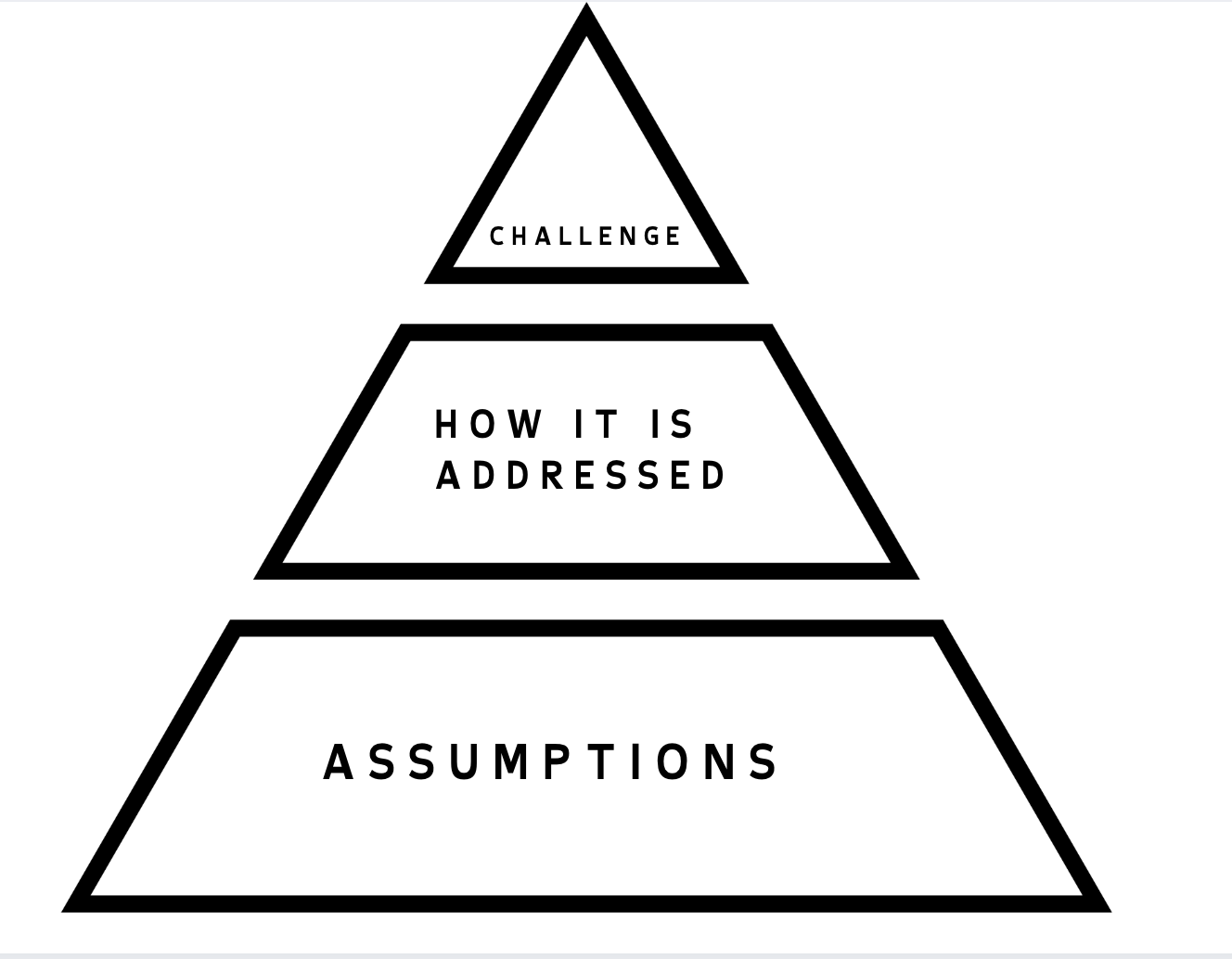
The Uncomfortable Pyramid helps panels explore the links between a visible challenge, how it is addressed and the assumptions underneath.
How we used it and what we learned
We used these tools as part of our Equality Fund 2025 grant-making training. The tools helped us explore differences in perspective rather than rush past them.
The Equality Fund supports work addressing inequality in Camden, so our panellists needed to think beyond whether a proposed activity sounded positive. We wanted them to consider the wider issue a project was responding to, the assumptions and barriers underneath that issue, and the kind of change the project could realistically contribute towards.
The tools gave the group a shared language for these conversations.
Different panellists brought different experiences, knowledge and perspectives into the room. Someone with lived experience might notice a barrier, strength or piece of context that was not obvious in the written application.
These tools give panels permission to pause. They make assumptions more visible. They help people explain why they see an application differently. They also encourage us, as funders, to question our own processes alongside the projects in front of us.
This reflects what we have seen across our wider participatory work. People take the responsibility of making funding decisions seriously. They want enough information, clear questions and the space to reach fair decisions.
The cookbook will not provide perfect answers, and it was never designed to. Instead, it is a starting point; a set of prompts to help people explore ideas, challenge assumptions and develop their own ways of thinking together.
We hope other grant-makers will try the recipes with their own panels and communities, adding their own seasoning along the way.We’re committed to finding new ways for communities to have a say in how our funds are spent and this was an important part of that. We’re also really delighted that the 5 organisations have all accepted their grants have really exciting plans to break the cycle of food bank reliance in Camden.