
What does inclusive growth mean to me?
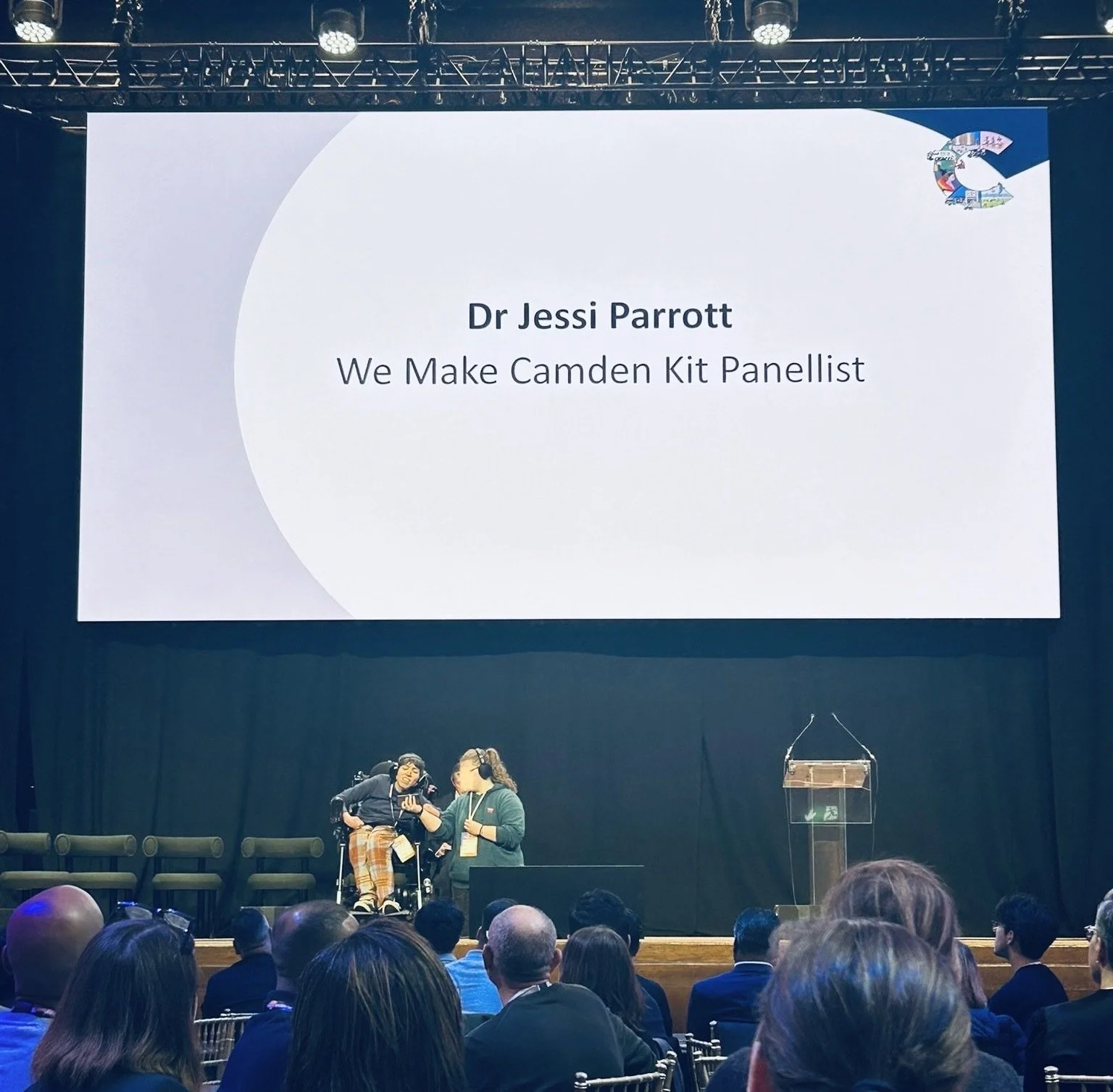
A wide shot of a stage at the We Make Camden Summit. On a large projector screen in the center, the text reads 'Dr Jessi Parrott, We Make Camden Kit Panellist.' Below the screen, Jessi Parrott, a white person with short brown hair, is seated in their power wheelchair on stage, wearing a dark blue top and orange plaid trousers. They are engaged in conversation with another person standing beside them. The back of the audience's heads are visible in the foreground, looking toward the stage.
Jessi Parrott’s Opening speech at the We Make Camden Summit 2026.
Hullo, I’m Jessi Parrott. My pronouns are they/them. I am a panellist with Camden Giving. I am a white non-binary person with short brown hair and brown eyes, and I am sitting in my powered wheelchair. I’m wearing a dark blue top and orange plaid trousers. I’m also wearing ear defenders.
I start like that for two reasons.
Firstly because audio description is a vital form of accessibility and, for me and many other deaf, disabled and neurodivergent people, inclusive growth has to mean accessible growth.
Secondly, telling you about my pronouns, and my wheelchair and ear defenders, positions me as a queer, trans, disabled and neurodivergent person – in my case as someone who is autistic and has Cerebral Palsy and who grew up in Camden as a queer young person in a queer family under Section 28, and whose gender identity is not recognised under the Equality Act 2010. It is also a form of the everyday performance that society requires from marginalised and multiply marginalised people.
I mention that because I am coming to this topic from three perspectives: as a person, panellist and someone who works as a performer. Those combined positions mean that what inclusive growth means to me is that everyone can show up fully as themselves in accessible and equitable environments, and that they know the people representing them have experiences of navigating the world that they can relate to.
Because representing means not only providing connection between communities and the structures of wider society, for instance, local councils and committees, or with my fellow panellists at Camden Giving – it means reflecting back to those communities, being a witness and a welcome. Sharing stories and holding space for others to feel safe enough to share theirs. Taking stock of where we are, whilst considering how far we have come and how far there still is to go – and grow.
So I guess, for me, what inclusive growth really means is belonging.
That people don’t have to be included any more.
That we are part of the fabric and threads of our borough’s and society’s narrative tapestry. Because we deserve to be – and we already are.
Thank you.
Jessi is one of twelve community members who is part of this year’s We Make Camden Kit Panel, if you’d like to apply to them to fund a great idea for Camden, you can find out more here.